Thursday, May 20, 2010

Final post

After a year of studying environmental issuses and modern day applications, I know believe that the greatest threat to our world is a lack of education. Sure it dosnt damage the envronment directly like pollution or overpopulation; however without education, we wouldnt even realize what was happening until it was to late to do anything about fixing the problem. Education is important for more reasons then just sustainable living, it also affects the overall health of humans by limiting the spread of diseases such asthe guinea worm.


Oceans are vital part of our world, that are often hurt by human activities. They provide both food and recreation for human society, and house a huge amount of biodiversity. Unfortunetly they are also a prime example of tragedy of the commons, as very few people have taken care of them, despite the fact that every one uses them.


During the year we not only studied the environment, but also examined the civil engineering field. Studying things like power plants, water purification, and sewage treatment plants. All necessary parts of modern infastructure, and all having various affects on the environment.


Over the course of the year we aslo took the mostimportant step towards a greener tommorrow. Educating ourselves to be able to make better decisions for our future. Even if we dont go on tobecome prt of the environmental field, at least we will become educated voters, helping our country become a better place.

Final Assignment: Sustainibility

Before starting APES this year, I thought sustainibility was only a financial method. Now, I understand that sustainibility is the duty and ability each human being on Earth has to use its resources equally so that they will beavailable for centuries to come. Through sustainibility, the human race is able to prosper greatly far into the future, but other issues of preserving Earth's resources have caused huge problems all over the world.

The massive population growth in India really caught my attention. Because of certain traditions and customs, most Indians, especially living in poverty, do not know the consequence that this massive growth is having on their country and its environmental well-being. Arranged marriages are predonminately performed around the country, and sometimes the relationships do not turn out for the better. Recently, efforts have been made to educate both spouses on problem solving, protected sexual activity, and the use of birth control. Especially in the slum areas of Mumbai, families tend to have 4-7 children at the least. Most families want to produce at least one male, in order to carry on the family name. The wives often feel obligated to their husbands and follow their requests, causing them to become very weak and ill. The children are not adequately fed, and they often resort to scaveging in landfills, full of hazardous wastes and other materials. Women in India are now becoming more involved through education of the world's overpopulation.

The Aral Sea is another thing I learned about in APES that really got my attention. Before the class, I already new it was small, but I didn't know exactly why. Once the world's fourth largest freshwater lake, the Aral Sea is what many scientists call the greatest ecological disaster in the world. During the reign of the Soviet Union, the government decided to divert large amounts of water from the Aral Sea as irrigation water for newly cultivated rice and cotton. Overtime, the sea began to shrink because so much water had been diverted to numerous areas across Asia. As the water began to disappear, so did the majority of the sea's native fish species. As displayed in the picture above, many fishing boats and other ships have been stranded in the desert formed by the shrinkage of the sea. The salinity of the Aral Sea is three times saltier than ocean water, and the lack of water has caused the large amount of salt to crystalize in the desert. As it is picked up by the wind, the salt can travel as far as the Himalaya Mountains, causing irritation to the human respiratory system. The Aral Sea also once served as a barrier for immense summer heat and extremely cold winter winds, but that barrier is gone and has caused major limate change in this part of the world. This is a display of the unexpected consequences when humans alter the natural flow of the environment.

I never realized how much of an impact literature had on environmental awareness and regulation until this year. The first work we learned about was Aldo Leopold's Sand County Almanac. Leopold is considered by environmentalists to the be one of the main drivers of the modern environmental and conservation movement. He also laid the foundation for the study of environmental ethics. Though his book was published in 1949, one year after his death, the environmental classic expresses Leopold's view; "the role of the human species should be to protect nature not conquer it". We also discussed Rachel Carson's Silent Spring. Published in 1962, the title of the story referred to the silencing of many birds because of their exposure to pesticides, particularly DDT. Carson decided to look into the issue herself and found that independent research on the environmental effects of pesticides was almost nonexistent. Through her efforts, DDT was banished from being used in the United States.

Sustainability: FINAL ASSIGNMENT


Before I'd taken his course, I imagined sustainability as the typical "save the trees" or "don't allow oil spills" stereotype that most people think of when they think about "saving the environment". Now I realize that sustainability has a multi-faceted definition that isn't limited to just the issues covered commonly by the media. Sustainability is the responsible and efficient use of our natural resources (renewable and nonrenewable) that will preserve and protect the organic life on our world, as well as provide a place to live for generations to come. The largest threat to sustainability, in my opinion, is the misuse of resources in affluent, developed countries. With developed countries using a majority of the resources in the world already, and with all of the developing countries on the rise, soon the demand for our natural resources will exceed the planet's capacity to produce them. The overuse of these resources is also morally irresponsible due to an affluent nation's ability to spend large amounts of money to enact environmentally friendly policies. This selfish mentality may be what ultimately leads us down our path of self-destruction in the future if it is not corrected soon.


This picture of the Three Gorges Dam depicts one of many ways that humans interfere with nature in order to bring convenience to their lives. While dams create clean fuel, they also cause significant habitat damage downstream from the dam's location due to the decreased flow of water.


Before APES, I'd never thought about the ecological impact of oysters before. However as we learned, the Chesapeake Bay oyster plays a key role in water filtration and is currently struggling for survival against the Japanese oysters that were brought there by humans. Learning about the frequency that invasive species appear in environments was something that surprised me alot during the course.


The importance of developing countries in the future was also something that surprised me and made a deep impression on me. Before, I thought that the power to save or destroy the environment was in the hands of the richer, more affluent countriies, but now i realize that that power truly lies in the hands of the developing countries that are growing.

Wednesday, May 19, 2010

Will Russell


An estimated 100 million trees are needed to create the 100 billion pieces of junk mail delivered to mailboxes every year. “30 percent of all mail delivered in the world is U.S. junk mail,” said Will Craven, a Forest Ethics spokesperson.

Through APES i learned that the amount of paper wasted everyday in the united states is exponentially hurting our environment. it has made me double think before i reprint a document in the library for a research paper. Before this AP Environmental class i printed alot of copies and printed many pages for research and projects. Now i carefully choose what information is important and only print that information. The picture shows how much a man found in his garage one day when cleaning it out. all of this paper was junk mail he had never thrown out. not important information but junk that he recieved over the years.

The picture showing PCB's bioaccumulating in the atmosphere strikes me when i see it. PCB's are also known as polychlorinated biphenyls. these man made chemicals are difficult to disolve and cause harm to humans, animals, plants, and the atmopsphere. they bio accumulate and are stored in the fatty tissue of organsims. PCB's attach to tiny particles and sink to the bottom of the ocean floor and then small organisms eat them, then fish eat the organism that contains PCB's in fatty tissue and the process continues through the food chain.

the picture of the book "Silent Spring" by Rachel Carson is a book from the 1960's spreading awareness of the harm of pesticides to the environment. She started the awareness by talking about what DDT, a harmful pesticide, did to the bald eagle. DDT bioaccumulated in Bald Eagles and harmed their eggs by making them weaker and when the Bald Eagle sat on their eggs the eggs would break. this started the rapid decline in the Bald Eagle Population.

Saturday, May 15, 2010

THE FINAL ASSIGNMENT

Now living Sustainably to me means paying attention to our environment and each individual doing the best they can to conserve there footprint in the world. It has to be your choice to live sustainably, no one can force someone to be. The major issue that scares me is what we are going to do when all the oil and fuel sources are gone. We depend on those non renewable resources more than you think and we use them without thinking about the consequences. I know precautions are being used, but that is not enough. Many scientists have been experimenting with new ideas, but in reality it takes a lot of money and work to create alternative energy sources such as wind turbines. I feel like money is contributing to how we can't live sustainably.


Strip mining is hurting our environment. This is a huge mining cite and look at what it has done to the land. Animals have been forced out of their habitats for mining and a cite like this one will never be able to recover and be the same.


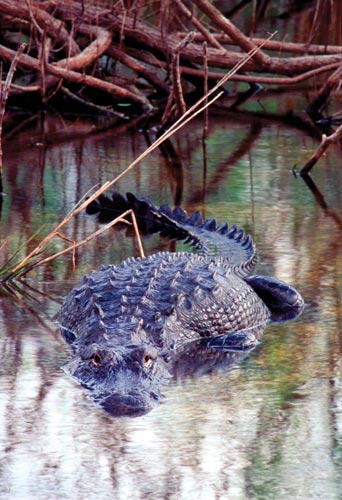
An Alligator is a keystone species. Keystone species are KEY to an ecosystem. Without them the animals in their habitat would not be able to survive.


The Ecological Footprint is how much a population uses the worlds resources. I remember doing surveys about each of our own footprints and how many worlds we used and I used 4.5 worlds to supply my needs. I really realized I need to help the environment more and limit my showers, brushing my teeth and pulling out utilities when they are not being used.

Thursday, May 13, 2010

APES STUDENTS FOR 2010-2011

Take a close look at the image to the right. I chose it
to start your year in APES because I want you to think about the world we live in and how APES 
will affect your thinking about the world.  Make a new post with your answer to the question, "Why I chose to take APES?"  This assignment is due by 
Wednesday, May 26. 

Wednesday, May 5, 2010

Sustainability: The FINAL Assignment

One of the goals of environmental science is to "learn how we can live more sustainably without degrading our life-support system." (Miller, LITE). Now that you've completed the course, I'd like you to reflect on what sustainability means and how your ideas have changed through the year.

Your posting should include the following:
1. Define sustainability, and discuss the major issues you feel are most problematic and preventing us from living sustainably. Be specific--show me that you've been attentive to the course.

2. Insert 3 images that that summarize your experience in APES.  Include at least 3 sentences describing why you chose the image.  Relate the image to your learning in APES.  You may use photos, maps, cartoons diagrams, etc.  Perhaps you are more scared about the issues facing us, perhaps you are more hopeful, perhaps one topic opened your eyes to information you never knew about. I want you to really think about what you learned this year and what affected you personally.


Have fun! The post is due Tuesday, May 25 (Everyone has this date, even though one class drops on that day.