Sunday, May 22, 2011
APES Summer Assignment
I have always enjoyed being outside in nature, and I like learning about everyday occurences. This class will be helpful to my understanding of the world. It is not specific to one branch of science so the study will be broad. An additional benefit is that as we post blogs on our discoveries, hopefully it will improve my understanding of the use of technology (in which area I am severly lacking).

Friday, May 20, 2011
Y do I want to take APES
The world of science is a fascinating study that we are so fortunate to have at NSA. I would like to take APES because it concerns the world around us and is affected by what we do everyday. My goal in the class is to deepen my understanding of the natural world and how we, as humans, both use it and harm it. Also Mrs. George is the best teacher ever.
Wednesday, May 18, 2011
Why I Want To Take APES
I am interested in taking AP Environment Science to better my understanding of the natural world and how humans affect it. As a member of the Environmental Club at school, I have gotten a glimpse of how we can change the world we are living in both in a beneficial and malignant way. My goal in taking this class is to learn more about the world we are changing, and hopefully to find more ways in which we can affect our planet benevolently.
Monday, May 16, 2011
SUMMER 2011: ASSIGNMENT
 One of the goals of environmental science is to "learn how we can live more sustainably without degrading our life-support system." (Miller, LITE). Reflect on what sustainability means and read some newspaper or magazine articles that discuss successes (things we are doing to live sustainably) and our problems (environmental issues that you feel are affecting sustainable living).
In your posting, you should define sustainability, discuss the major issues you feel are most problematic and include positive steps you feel are being taken. Give specific examples of problems/solution (don't just say "pollution) and cite the articles in a hyperlink so that others can read them as well. You may address local, national or worldwide issues.
You may wish to start this assignment by reading Chapter 1 of Miller LITE for an overview of environmental science. Be sure to take the poll on the right side of this page!
Read what others post and make comments on their ideas. This is your forum for discussion!
Wednesday, May 11, 2011
Last APES Blog
The textbook definition for sustainability is the ability of earth's systems, including human cultural systems and economies, to survive and adapt to changing environmental conditions indefinitely. According to me, sustainability is living on this Earth while not exploiting the natural resources available and preserving the resources for the future.
One problem that was brought to my attention when I took APES this year was the "tragedy of the commons". Had I not taken APES, there is a very small chance that I would have become aware of such a big problem.The tragedy occurs because each user of a shared common resource or open-access resources exploits the shared resource because one does not own it. The cumulative effect of this exploitation works to exhaust or ruin the resource. Unfortunately, developing countries and industrialized nations participate in such activities whether that be by dumping trash in the ocean or testing missiles in the sky. If a person owns a resource, then he or she most definitely wants to protect it in order to make it most profitable to them. However, when no one owns the resource, then no one takes responsibility for caring for it and instead want to exploit it to make it most profitable to them. There were many other problems that we discussed in APES but this problem stuck out to me because we see this tragedy going on in all places that belong to the public whether that be a park or a school. This is one problem which I know can be solved because this problem has been caused by humans. Therefore, I am hopeful that if us, as humans, begin to take responsibility for the resources we use and try to not to exploit them, then there is a possibility that the problem of the "tragedy of the commons" could be solved.If we continue to live with the mindset to exploit what does not belong to us, then we are not only setting ourselves up for trouble in the future but we are jeopardizing the future of the Earth.

This image to me is the perfect example of the "Tragedy of the Commons". It is an image of San Diego's Balboa Park, which was trashed after Earth Day celebrations in 2008. Because this is a public park, no one took the responsibility to go dispose their trash in an appropriate location. There was no one to enforce that the trash be dumped in the appropriate location, and this trash is the result of the "tragedy of the commons". The irony of the picture is that this trash was left behind after the Earth Day celebrations, which, to me, is a little shocking because Earth Day is a celebration of trying to preserve the Earth. To me this image is disheartening, but I am still optimistic because I feel that the word is slowly spreading about the destruction we are causing to the environment, and so hopefully, 10 years from now, students taking this class may not have to learn about the "tragedy of the commons" because the problem will be extinct.
Another problem is that we often do not realize the importance of things we have always had. As a girl living my entire life in America, I have never realized the importance of education because it was always given to me. However, one thing that I feel that prevents our society from living sustainably is the lack of education especially amongst women. From this course, I feel the message that will remain with me for many years is the importance of the education of women. Educating woman empowers women. When women are empowered, they feel a greater sense of duty instead of just doing the daily chores and giving birth. As a result, this can lower fertility rates and ultimately slow down the population growth.

This image creates a very powerful message. Clearly, the women in the village are attempting to read in this image. I chose this image because I think that if this picture would mirror the women of the world, then nothing could stop the human race from becoming more sustainable. This picture serves to provide the hope that perhaps there will be a day where all women will be educated so that their talent will not be undermined. In many industrialized nations, the man to woman ratio is about equal. However, there are many developing countries where females are still suppressed. The image shows that it may take time, but, gradually, the women will be empowered through education. The education of these women will lead to lower fertility rates, slowing population growth, and ultimately reduce the environmental degradation.
Had I not taken environmental science, I probably would have never encountered the problem of affluence. From my childhood, I had always heard of problems of poverty and how there are many kids in the world that they do not even get 3 full meals. However, the problem of affluence was relatively surprising but it was very true. At the beginning of the year, we did a worksheet which talked about how we would need 4 to 5 Earths in order to support all of the resources just the United States. Affluence is a part of countries that are built on high levels of consumption and unnecessary waste of resources. Affluence, I believe, is worst than poverty because we have to exploit the resources of the Earth to get products because we, in America and other countries, are victims of the mass advertising industry. Even though the United States does not support the largest population of the world, we consume 100 times as much as the average person in the world's poorest countries. There may be some positives to affluence such as cleaner air, cleaner water, etc. in the United States, but this does not outweigh the harms we are causing.

This is a picture of old cell phones that are thrown in the trash, and they now sit at the dump. The image shows how we are all victims of the advertising of mass industries and one of the causes of affluence. From the thick cell phone, to the green light cell phone, to the keypad cellphone, to the touchscreen cell phone, technology is rapidly coming up with something newer and better. We try to stay updated by purchasing these products and fuel the negative effects caused by affluence. This picture, to me, serves as an eye opener for us to try not to be the victim of the industries because at the end we are hurting the environment by practicing unsustainable behavior.
Overall, I have learned about problems that I do not think I would have ever encountered from any other class. After taking this class, I have realized that I, too, contribute to the unsustainable resource use. Due to my conclusion, I learned to take little steps to try to cut down on my habits that would hurt the Earth. Slowly, as education and awareness spreads about the harms that we do to the Earth, and as people realize that we only have ONE Earth, we will become a more sustainable society to preserve this wonderful place for future generations.
One problem that was brought to my attention when I took APES this year was the "tragedy of the commons". Had I not taken APES, there is a very small chance that I would have become aware of such a big problem.The tragedy occurs because each user of a shared common resource or open-access resources exploits the shared resource because one does not own it. The cumulative effect of this exploitation works to exhaust or ruin the resource. Unfortunately, developing countries and industrialized nations participate in such activities whether that be by dumping trash in the ocean or testing missiles in the sky. If a person owns a resource, then he or she most definitely wants to protect it in order to make it most profitable to them. However, when no one owns the resource, then no one takes responsibility for caring for it and instead want to exploit it to make it most profitable to them. There were many other problems that we discussed in APES but this problem stuck out to me because we see this tragedy going on in all places that belong to the public whether that be a park or a school. This is one problem which I know can be solved because this problem has been caused by humans. Therefore, I am hopeful that if us, as humans, begin to take responsibility for the resources we use and try to not to exploit them, then there is a possibility that the problem of the "tragedy of the commons" could be solved.If we continue to live with the mindset to exploit what does not belong to us, then we are not only setting ourselves up for trouble in the future but we are jeopardizing the future of the Earth.
This image to me is the perfect example of the "Tragedy of the Commons". It is an image of San Diego's Balboa Park, which was trashed after Earth Day celebrations in 2008. Because this is a public park, no one took the responsibility to go dispose their trash in an appropriate location. There was no one to enforce that the trash be dumped in the appropriate location, and this trash is the result of the "tragedy of the commons". The irony of the picture is that this trash was left behind after the Earth Day celebrations, which, to me, is a little shocking because Earth Day is a celebration of trying to preserve the Earth. To me this image is disheartening, but I am still optimistic because I feel that the word is slowly spreading about the destruction we are causing to the environment, and so hopefully, 10 years from now, students taking this class may not have to learn about the "tragedy of the commons" because the problem will be extinct.
Another problem is that we often do not realize the importance of things we have always had. As a girl living my entire life in America, I have never realized the importance of education because it was always given to me. However, one thing that I feel that prevents our society from living sustainably is the lack of education especially amongst women. From this course, I feel the message that will remain with me for many years is the importance of the education of women. Educating woman empowers women. When women are empowered, they feel a greater sense of duty instead of just doing the daily chores and giving birth. As a result, this can lower fertility rates and ultimately slow down the population growth.
This image creates a very powerful message. Clearly, the women in the village are attempting to read in this image. I chose this image because I think that if this picture would mirror the women of the world, then nothing could stop the human race from becoming more sustainable. This picture serves to provide the hope that perhaps there will be a day where all women will be educated so that their talent will not be undermined. In many industrialized nations, the man to woman ratio is about equal. However, there are many developing countries where females are still suppressed. The image shows that it may take time, but, gradually, the women will be empowered through education. The education of these women will lead to lower fertility rates, slowing population growth, and ultimately reduce the environmental degradation.
Had I not taken environmental science, I probably would have never encountered the problem of affluence. From my childhood, I had always heard of problems of poverty and how there are many kids in the world that they do not even get 3 full meals. However, the problem of affluence was relatively surprising but it was very true. At the beginning of the year, we did a worksheet which talked about how we would need 4 to 5 Earths in order to support all of the resources just the United States. Affluence is a part of countries that are built on high levels of consumption and unnecessary waste of resources. Affluence, I believe, is worst than poverty because we have to exploit the resources of the Earth to get products because we, in America and other countries, are victims of the mass advertising industry. Even though the United States does not support the largest population of the world, we consume 100 times as much as the average person in the world's poorest countries. There may be some positives to affluence such as cleaner air, cleaner water, etc. in the United States, but this does not outweigh the harms we are causing.
This is a picture of old cell phones that are thrown in the trash, and they now sit at the dump. The image shows how we are all victims of the advertising of mass industries and one of the causes of affluence. From the thick cell phone, to the green light cell phone, to the keypad cellphone, to the touchscreen cell phone, technology is rapidly coming up with something newer and better. We try to stay updated by purchasing these products and fuel the negative effects caused by affluence. This picture, to me, serves as an eye opener for us to try not to be the victim of the industries because at the end we are hurting the environment by practicing unsustainable behavior.
Overall, I have learned about problems that I do not think I would have ever encountered from any other class. After taking this class, I have realized that I, too, contribute to the unsustainable resource use. Due to my conclusion, I learned to take little steps to try to cut down on my habits that would hurt the Earth. Slowly, as education and awareness spreads about the harms that we do to the Earth, and as people realize that we only have ONE Earth, we will become a more sustainable society to preserve this wonderful place for future generations.
Final Blog- Tasha Koduri
Reuse, Reduce, Recycle. When I walked into environmental, this was I thought the epitome of sustainability was, but after taking APES I have learned that sustainability is much more. A dictionary definition of sustainability is "relating to, or being a method of harvesting or using a resource so that the resource is not depleted or permanently damaged", yet sustainability is the key to solving many problems that plague our world like hunger. One problem that I have learned that greatly impacts sustainability is population growth. For example, when an area is too highly populated, the resources are strained and limited, which thus causes unsustainable use of obtaining more resources for the demanding and growing population. Sustainability takes a back seat when people are putting on pressure for more resources, and often resources are used that cannot be replenished. This is seen with non-renewable resources like natural gas and petroleum. The growing population needs electricity, fuel for their cars, and heat for their homes, and the easiest resource to provide for all these needs is natural gas/petroleum. However, these non-renewable resources degrade the natural environment and are non-renewable which means that they cannot be replaced, so once it is gone, we are never going to be able to use it. Both of these characteristics of natural gas/petroleum violate the main principles of sustainability. Another problem that is hindering us from living more sustainable is that the general public is not educated on what is sustainable versus what is not. For example, I did not know how unsustainable I was being by using plastic water bottles. I always buy plastic water bottles because they are portable and are easy to buy, but the cost of making, transporting, and handling the water bottles afterwards is ridiculous. Most people do not understand the implications that arise from buying water bottles/ the major environmental problems especially pollution of our air from transporting the bottles, and pollution of our waterways from the disposal of the water bottles which ultimately endangers and even kills many animals that mistake these water bottles for food. Thus, the only way that people will understand is if they are educated on the environmental problems that arise from the simple use of everyday items like water bottles.

Picture #1: This represents the extreme water pollution that occurs in many developing countries. The sad part is that this type of pollution is common and is a growing concern since many of these countries do not regulate waste disposal, which results in this type of pollution. In addition, the pollution we cause today affects many people in the future because this water could have once been a potable drinking water source, but now a lot of money will be needed before anyone will be able to drink water out of this river again.

Picture #2: This picture represents the ever-growing problem of endangered species. People are the cause of many of these organisms near extinction because we hunt, kill, and trade these organisms to the point where they are in danger of being wiped off the planet forever. If humans continue to wipe out more and more species, there will be no more organisms to balance out the food chain/webs, which will ultimately destroy the human population and the world’s biodiversity.
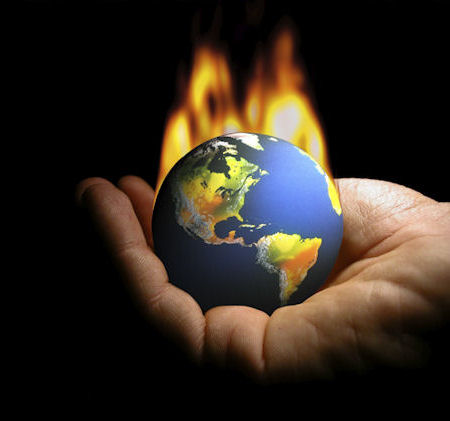
Picture #3: This picture represents a problem that is constantly in the news...humans are causing global climate change. The Inconvenient Truth, by Al Gore, really highlights how we are causing a surge in the amount of greenhouse gases. Ultimately, the earth does need a certain amount of greenhouse gases to sustain life, but we are adding to much greenhouse gas into the atmosphere changing the climate and destroying our world. We are part of the problem, and if we do not change the way we live, the our world’s ability to sustain life could very well be at stake.
Picture #1: This represents the extreme water pollution that occurs in many developing countries. The sad part is that this type of pollution is common and is a growing concern since many of these countries do not regulate waste disposal, which results in this type of pollution. In addition, the pollution we cause today affects many people in the future because this water could have once been a potable drinking water source, but now a lot of money will be needed before anyone will be able to drink water out of this river again.
Picture #2: This picture represents the ever-growing problem of endangered species. People are the cause of many of these organisms near extinction because we hunt, kill, and trade these organisms to the point where they are in danger of being wiped off the planet forever. If humans continue to wipe out more and more species, there will be no more organisms to balance out the food chain/webs, which will ultimately destroy the human population and the world’s biodiversity.
Picture #3: This picture represents a problem that is constantly in the news...humans are causing global climate change. The Inconvenient Truth, by Al Gore, really highlights how we are causing a surge in the amount of greenhouse gases. Ultimately, the earth does need a certain amount of greenhouse gases to sustain life, but we are adding to much greenhouse gas into the atmosphere changing the climate and destroying our world. We are part of the problem, and if we do not change the way we live, the our world’s ability to sustain life could very well be at stake.
Monday, May 9, 2011
Too Many People/ anna cait
To me, sustainability means endurance. It means that as a human race, we are living in a fashion that can continue to support us indefinitely. In order to do this, we must embody an environmental stewardship worldview by using only what we need and allowing other species to use this earth as their home as well.
Today, there are several things that pose a threat to our living sustainable, one of which is population growth. 1.6 million babies per week a
Today, there are several things that pose a threat to our living sustainable, one of which is population growth. 1.6 million babies per week a
re born. In just about 40 years, the
world population is expected to grow from 6.7 to 9.3 billion people. Mos
t of this growth is sourced from China and India, developing countries growing on a large scale. The problem stems from both the sheer volume of people from developing countries that demands huge amounts of resources, but also from affluency in developed countries. Citizens of the United States fro example, like things, and lots of them. When each family has a large house, a few cars, and tons of stuff to fill them with, a lot of resources are used and a lot of waste is produced.
With many technological and medical advancements, we as humans are able to combat natural checks on population growth. Limits that used be in place, such as certain diseases, or even a certain climate that used to be too hot to live in, are now combated
With many technological and medical advancements, we as humans are able to combat natural checks on population growth. Limits that used be in place, such as certain diseases, or even a certain climate that used to be too hot to live in, are now combated
with vaccines and air conditioning. Many are worried about a solution to this problem, as most people feel it is an invasion of their privacy for their reproduction to be regulated. Acknowledging that at this moment one out of five people do not have their basic needs met, and we have another 2.6 billion on the way, it is obvious that we have a big problem.


Picture #1 This picture is from The Story of Stuff. It displays the crisis we

are in in America. The president recommended that citizens shop to help the economy. By saying that we need more and more stuff in order to have a strong nation, people receive a distorted message about priorities from their leader.
Picture #2 This diagram depicts a modern landfill in developed countries. It represents progress and how new technolo
gies are helping to keep our earth clean. The leachate collection system is designed very carefully to ensure nothing leaks into the groundwater supply or soil and contaminates it.
Picture #3 The recycle sign looks simple. However, it represents that many people believe that by simply recycling they are "being green". In reality, recycling should be a no brainer and perhaps required by the government. It is important to remember that recycling is the last resort. The principles of reduce and reuse should be applied first.
That's all for now folks :)
Subscribe to:
Posts (Atom)